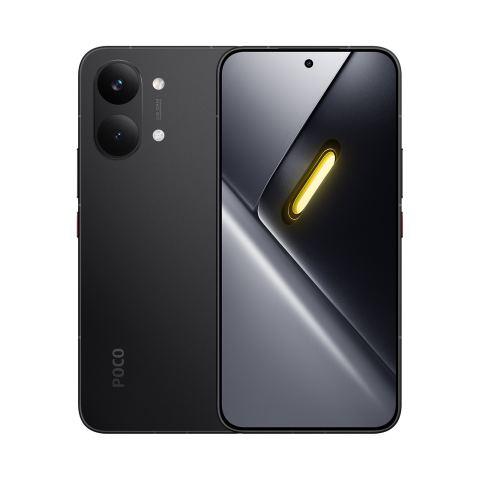
POCO F6 Pro vs POCO X8 Pro Max: specs and versions compared
Published
The POCO F6 Pro and POCO X8 Pro Max side by side: the memory, storage and colour versions we list, and the screen, battery, charging, camera and SIM details POCO publishes for each, with live prices on the product cards.
The POCO F6 Pro and the POCO X8 Pro Max are both 5G phones with 12 GB of memory in the versions we list, but they differ where it shows in daily use. The POCO X8 Pro Max has the larger battery (8500mAh against 5000mAh), a slightly larger screen and eSIM support. The POCO F6 Pro has the sharper screen resolution, faster 120W charging and a slightly smaller, lighter body, and it started at a lower price than the X8 Pro Max when we checked on 15 November 2026.
Both are sold by Xiaomi's UK store and appear in our mobile phone listings. Prices change often, so we do not print them here: the current price of each version is on the product cards below the article.
How are the two phones related?
POCO is a Xiaomi brand with several model families. The F6 Pro belongs to the F line, POCO's higher family, but it is an earlier generation: the F line in our listings has since reached the F9 Pro and F9 Ultra. The X8 Pro Max is the top model of the current X8 family, which also includes the X8, X8s and X8 Pro.
So this is a choice between an earlier model from the higher line and the newest model from the line below it. That is why the two overlap in memory and storage while differing in battery, screen and price.
Which versions do we list?
These details come from the product titles in our listings, as supplied by Xiaomi UK, and were checked on 15 November 2026. The first figure is memory (RAM) and the second is storage.
| POCO F6 Pro | POCO X8 Pro Max | |
|---|---|---|
| Versions listed | 12 GB + 256 GB, 12 GB + 512 GB | 12 GB + 256 GB, 12 GB + 512 GB |
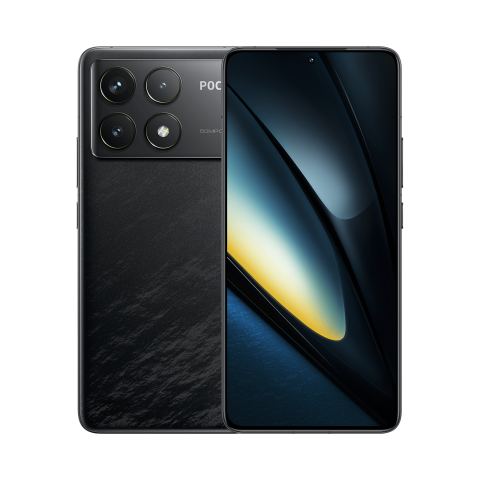
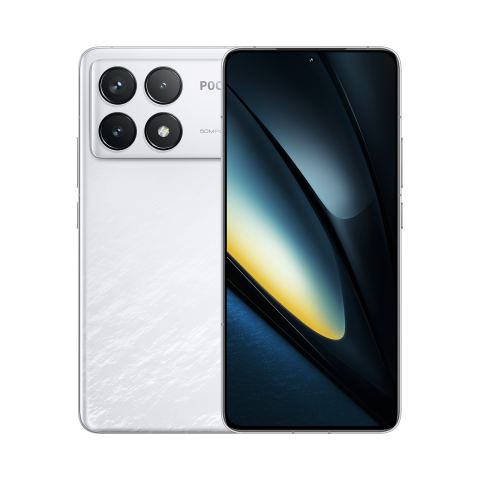
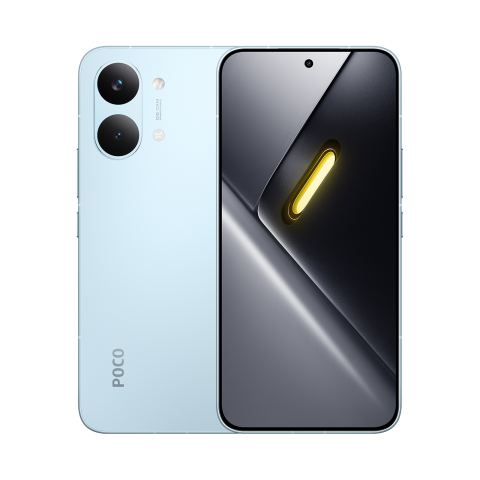
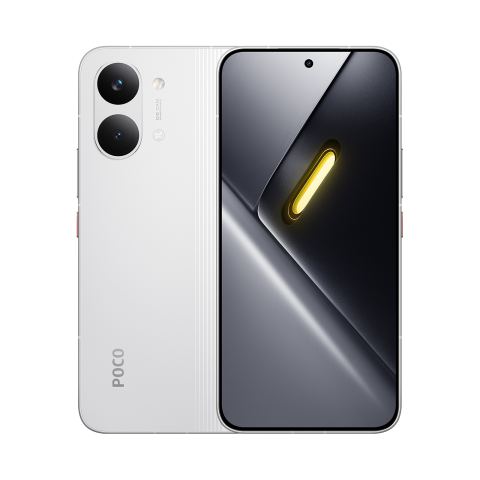
| Colours listed | Black, White | Black, Blue, White |
| Colour and version pairs | Black in 256 GB, White in 512 GB | Black and White in both sizes, Blue in 256 GB |
| Starting price when checked | Lower of the two | Higher of the two |
Other versions exist. POCO's specification for the F6 Pro also names a 16 GB + 1 TB version, which was not available in our listings when we checked. The cards below show only what can be bought now.
Specifications compared
Xiaomi's feed does not include specifications, so the figures in this table come from POCO's own specification pages for each model on po.co, read on 15 November 2026. Those are POCO's global pages, and POCO notes that some features vary by market, so confirm the details on the Xiaomi UK product page before you buy.
| POCO F6 Pro | POCO X8 Pro Max | |
|---|---|---|
| Processor | Snapdragon 8 Gen 2 | MediaTek Dimensity 9500s |
| Screen | 6.67 inch AMOLED | 6.83 inch AMOLED |
| Resolution | 3200 x 1440 (WQHD+) | 2772 x 1280 (1.5K) |
| Refresh rate | Up to 120Hz | Up to 120Hz |
| Battery | 5000mAh (typical) | 8500mAh (typical) |
| Wired charging | 120W HyperCharge | 100W HyperCharge |
| Rear cameras | 50MP main, 8MP ultra-wide, 2MP macro | 50MP main with optical image stabilisation, 8MP ultra-wide |
| Front camera | 16MP | 20MP |
| Size | 160.86 x 74.95 x 8.21 mm | 162.9 x 77.9 x 8.2 mm |
| Weight | 209 g | 218 g |
| Mobile network | 5G, 4G, 3G, 2G | 5G, 4G, 3G, 2G |
| SIM | Dual SIM: two nano SIMs | Dual SIM: two nano SIMs, or one nano SIM and an eSIM |
| NFC | Yes | Yes |
POCO states that 5G depends on region and network, and that NFC functions may vary in some markets.
Battery and charging
This is the largest difference on paper. POCO gives the X8 Pro Max a typical capacity of 8500mAh, which is 70 per cent more than the 5000mAh of the F6 Pro. Capacity is not the same as hours of use, because the screen and processor also decide how fast a battery drains, but a gap that size matters if you are often away from a socket.
The F6 Pro charges at a higher peak power: 120W against 100W. With a much smaller battery to fill, it is the one built for short top-ups. POCO also lists wired reverse charging of up to 27W for the X8 Pro Max, which lets the phone charge another device by cable.
Both wattage figures assume a charger of that power. Check the "in the box" section of the product page to see whether one is included.
Screen and size
Both have AMOLED screens that refresh at up to 120Hz. The F6 Pro has more pixels on a slightly smaller panel, so its picture is finer in detail. The X8 Pro Max is larger at 6.83 inches, and POCO states a peak brightness of 3500 nits for it. We did not record a comparable figure for the F6 Pro, so we do not compare brightness here.
In the hand, the X8 Pro Max is about 2 mm taller, 3 mm wider and 9 g heavier. The two are the same thickness to within a fraction of a millimetre, despite the difference in battery.
Cameras
Both have a 50MP main camera and an 8MP ultra-wide. The F6 Pro adds a 2MP macro camera for close-ups; the X8 Pro Max has two rear cameras and a higher-resolution 20MP front camera. Megapixels describe the size of the image, not its quality, and we have no way to judge the photos from a specification, so treat the cameras as broadly similar on paper and look at sample photos if photography is a priority.
Processor, memory and storage
The two use chips from different makers: a Qualcomm Snapdragon 8 Gen 2 in the F6 Pro and a MediaTek Dimensity 9500s in the X8 Pro Max. The X8 Pro Max is the newer phone with the newer chip. We do not publish benchmark figures, so we do not rank them.
In our listings both come with 12 GB of memory and a choice of 256 GB or 512 GB of storage. If you film a lot of video or keep large games, take the 512 GB version, because storage cannot be added inside the phone later. Note that the F6 Pro's 512 GB version is listed in white only, and its 256 GB version in black only.
SIM and eSIM
Both take two SIMs. The X8 Pro Max can use an eSIM as its second line; POCO's specification for the F6 Pro lists two nano SIMs and does not mention eSIM. If your network gave you an eSIM, or you want one for travel, that points to the X8 Pro Max.
Which one should you buy?
- For the longest time between charges: the POCO X8 Pro Max, with the much larger battery.
- On price: compare the cards above for today's figures; the two change places as offers come and go.
- For the sharper screen and faster charging: the POCO F6 Pro.
- For eSIM, a choice of colours or the newer model: the POCO X8 Pro Max.
- For a specific colour and storage size: check the cards, because the F6 Pro is listed in one colour per size.
An earlier model usually has fewer years of software updates left than a new one. We could not confirm the update period for either phone, so check Xiaomi UK's product page if you plan to keep the phone for a long time.
Where to compare
See both phones with every other model on the Xiaomi phones page, or everything we list from Xiaomi. Our POCO vs REDMI guide covers the rest of the X8 family and the REDMI Note 17 series, and where to buy Xiaomi in the UK explains what to check before ordering. For a battery pack to go with either phone, see Xiaomi power banks compared, or browse phone accessories.
Questions and answers
Is the POCO X8 Pro Max newer than the POCO F6 Pro?
Yes. The F6 Pro is an earlier F-series model, while the X8 Pro Max is the top model of the current X8 family in our listings.
Which has the bigger battery, the POCO F6 Pro or the X8 Pro Max?
The POCO X8 Pro Max. POCO gives it a typical capacity of 8500mAh, against 5000mAh for the F6 Pro.
Which charges faster?
POCO lists 120W HyperCharge for the F6 Pro and 100W HyperCharge for the X8 Pro Max. Both figures need a charger of that power.
Do both phones have 5G?
Yes. POCO's specifications list 5G for both, and note that 5G service depends on your region and network.
Does the POCO F6 Pro support eSIM?
POCO's specification for the F6 Pro lists two nano SIMs and does not mention eSIM. The X8 Pro Max can use a nano SIM with an eSIM.
Which memory and storage versions are listed?
On 15 November 2026 both were listed with 12 GB of memory and either 256 GB or 512 GB of storage. The product cards show which colours are available in each size now.